EPDM, TPO or modified bitumen: which flat roof fits your Manhattan building?
Short answer: All three can work on a Manhattan flat roof, and a good install matters more than the brand. For a roof that gets foot traffic, pavers or a lot of rooftop equipment, modified bitumen is the toughest. For a large open roof that needs to stay cool, a white TPO or PVC membrane is usually the best fit. EPDM is simple to repair and works well on small, plain roofs, but in NYC it must be white or coated to meet the cool-roof rule on bigger replacements.
We install all three, mostly with Johns Manville materials. On brownstones and small walk-ups we usually recommend a two-ply modified bitumen roof: it handles the many corners, parapets and skylights on those roofs and stands up to people walking on it. On large, open co-op and commercial roofs we usually recommend white TPO, and PVC where restaurant exhaust lands on the roof. EPDM we mostly repair and extend on buildings that already have it, or use on small, plain roofs where the owner prefers rubber.
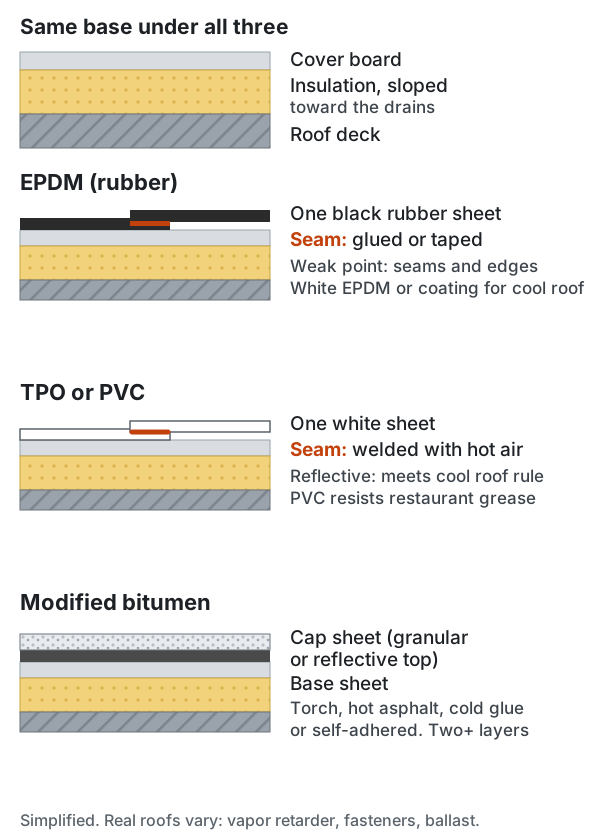
The three systems at a glance
| Feature | EPDM (rubber) | TPO / PVC | Modified bitumen |
|---|---|---|---|
| What it is | Synthetic rubber sheet | Thermoplastic sheet | Asphalt with SBS or APP polymers, in rolls |
| Layers | One | One | Usually two or more |
| How seams are joined | Adhesive or seam tape | Melted together with hot air | Torch, hot asphalt, cold adhesive or self-adhered |
| Usual color | Black (white available) | White | Granulated cap sheet or coating |
| NYC cool-roof rule | Needs white EPDM or a coating | White sheet usually meets it | Needs a reflective cap sheet or coating |
| Torch on the roof? | No | No | Only for torch-applied versions |
| Strong point | Easy to patch, flexible in cold | Welded seams, reflective | Thick, multi-layer, handles foot traffic |
| Weak point | Seams depend on adhesive or tape | Needs skilled welding and good detailing | Torch work needs FDNY-certified crews; heavier |
What’s on your roof now?
You can often tell from the hatch, without walking on the roof:
- EPDM: usually black, matte and slightly rubbery. Seams overlap and are glued or taped. Older EPDM can leave a chalky residue on your hand.
- TPO or PVC: usually white or light gray and smooth. Seams are welded, so you see a neat, flat edge where sheets overlap.
- Modified bitumen: either a granular surface, like the top of an asphalt shingle, or a smooth coated surface. Overlaps often show a thin line of asphalt that squeezed out when the seam was torched or set.
- Silver or white paint over any of these: a coating, often added later for reflectivity or to extend the roof’s life.
Knowing what you have helps, because some repairs and recovers only work with matching or compatible materials.
EPDM rubber roofing
EPDM is a large sheet of synthetic rubber. On a small roof it can often go down in one piece, so there are few seams. It stays flexible in winter and is easy to patch years later.
The weak spots are the seams and the flashing details, because they rely on adhesive or tape rather than a weld. Most EPDM is black, which absorbs summer heat. In NYC, unless the job is under 50 percent of the roof and under 500 square feet, the new surface has to meet the city’s reflectance standard (Building Code 1504.9 and 1511.1), so you need white EPDM or a reflective coating.
Older EPDM sheets can also shrink over time and pull at the edges and flashings, which is a common leak point on aging rubber roofs.
Good fit: small brownstone roofs with few penetrations, roofs that rarely see foot traffic.
TPO and PVC membranes
TPO and PVC are single-ply sheets whose seams are melted together with hot air. A good weld becomes one piece with the sheet, so seams are a strength rather than a weak spot. They come in white, which helps with the cool-roof rule and keeps top-floor apartments cooler in summer.
PVC holds up better than TPO against grease and many chemicals. That makes it the usual choice near restaurant exhaust fans on mixed-use buildings.
Both need careful detailing around drains, curbs and parapets. A badly welded corner leaks just like a bad seam on any other roof.
Good fit: larger open roofs, co-op and commercial roofs, roofs under restaurant exhaust (PVC).
Modified bitumen (torch-down and torch-free)
Modified bitumen is asphalt reinforced and modified with rubber-like (SBS) or plastic-like (APP) polymers. It goes down in rolls, usually as a base sheet plus a cap sheet, so you end up with two or more layers. That makes it thick and forgiving under foot traffic, pavers and equipment work.
It can be torched on, set in hot asphalt, glued with cold adhesive, or self-adhered. In New York City, torch-applied roofing has to be done by a holder of an FDNY Certificate of Fitness G-60, with an F-60 fire guard on the roof. Near wood cornices, old skylights or on buildings where the board is nervous about flames, torch-free versions avoid the open flame.
Cap sheets come granular or smooth. Granules protect the asphalt from sun and wear but can wash off over the years. Standard cap sheets are dark, so for most NYC replacements you need a white or “cool” reflective cap sheet, or a coating, to meet the cool-roof rule.
Good fit: roofs with foot traffic, roof decks, lots of equipment, older buildings where a multi-layer system adds margin.
How to choose for your building
- Who walks on the roof? Tenants, a roof deck or frequent HVAC service favor modified bitumen or a thicker membrane with walkway pads.
- What’s on the roof? Restaurant exhaust points to PVC. Planned solar or a green roof needs a membrane rated for that overburden.
- Where does the water go? Ponding water shortens the life of any membrane. If water sits for days after rain, the fix is drains and tapered insulation that slopes the roof, not just a new sheet.
- How big and how open? Large open roofs suit wide single-ply sheets. Small, cut-up brownstone roofs with many corners suit systems your roofer can detail well.
- Fire and access. Torch work needs FDNY-certified crews and may worry a co-op board. Torch-free options exist for every system here.
- NYC rules. Unless the job is under 50 percent of the roof and under 500 square feet, the new surface must be reflective. Replacing the whole roof assembly brings in the solar or green roof law. See our guide to NYC roof permits.
- Who installs it. A crew that installs one system every week will do better work than a crew trying a new one on your roof. Ask which system they install most. Send us photos of your roof and we’ll tell you which system we would put on it, and why.
What fails first on each system
On Manhattan roofs, the membrane itself is rarely the first thing to go. The joints are.
- EPDM: seams that were glued or taped come open, and old sheets shrink and pull at the edges and flashings.
- TPO and PVC: badly welded corners and patches around drains, curbs and pipes. A sheet that was welded well tends to stay watertight for a long time.
- Modified bitumen: blisters where moisture was trapped, granules washing off the cap sheet, and laps that open where water sits.
- All three: flashing where the roof meets the parapet or bulkhead, and ponding around blocked or badly placed drains. Most of the leaks we fix start there, whatever the membrane.
That’s why we spend more time on flashing and drainage than on which brand of sheet goes down. Our flat roofing page explains how we handle those details, and the roof repair page shows the repairs for each one.
What each system costs
The membrane is a smaller part of the bill than most people expect. A full new flat roof with us is typically $13 per sq ft, which covers tearing off the old roof, new insulation, a new roof layer, and new flashing at the roof joints. Whether the top layer is EPDM, TPO or modified bitumen moves that number less than how many old layers come off, whether the insulation is wet, how much parapet and flashing work there is, and how hard the roof is to reach. Our roof replacement cost guide explains how to budget, and new roofs carry a 2-year labor warranty, plus a 20-year manufacturer warranty on materials.
FAQ
Which flat roof material lasts longest?
It depends more on the install, the drainage and the details than on the material. A well-detailed roof that drains properly outlasts a better membrane put down badly over standing water. Ask any roofer how long their installs of that system have lasted on buildings like yours, and what the written warranty covers.
Which is cheaper, TPO or EPDM?
On price lists the two are close, and the membrane is only part of the bill. On a Manhattan roof, tear-off, insulation, flashing at parapets and bulkheads, and getting materials up and debris down usually decide the total. With us, a full new flat roof is typically $13 per sq ft, whichever of the two goes on top.
Is torch-down roofing allowed in NYC?
Yes. The torch work must be done by someone holding an FDNY Certificate of Fitness G-60, with an F-60 fire guard watching. Torch-free modified bitumen and single-ply membranes are options when open flame is a concern.
Can a new membrane go over my old roof, like TPO over EPDM?
Sometimes. The NYC Building Code (section 1511.3.1.1) does not allow a recover when the existing roof is water-soaked or too deteriorated to be a base, when it is slate or tile, or when the roof already has two or more layers of roofing. In those cases everything comes off down to the deck. Otherwise a recover is allowed only if the new membrane’s manufacturer allows it over the existing one, which for TPO over EPDM usually means a separating layer or cover board. Wet insulation or a damaged deck means a tear-off. We check first with a moisture meter and a small test cut, patched the same day, to see how many layers are there and whether the insulation is dry.
Sources
Official sources checked for this guide. Rules change, so check the current version before you rely on it.
- Building Code 1504.9 and 1511.1 (nyc.gov)
- Certificate of Fitness G-60 (nyc.gov)
- F-60 (nyc.gov)
- solar or green roof law (nyc.gov)