Repair or replace your flat roof? How to decide
Short answer: Repair a flat roof when the problem is in one place and the roof around it is dry. Replace it when the insulation is wet across large areas, leaks keep turning up in new places, or the building already has two or more roofs on it, because then the city’s building code requires the old layers to come off. In between there are two more options people often don’t hear about: a coating over a worn but dry roof, and replacing just one section. The way to know which one you’re looking at is a test cut and moisture readings, not the roof’s age.
The decision in one chart
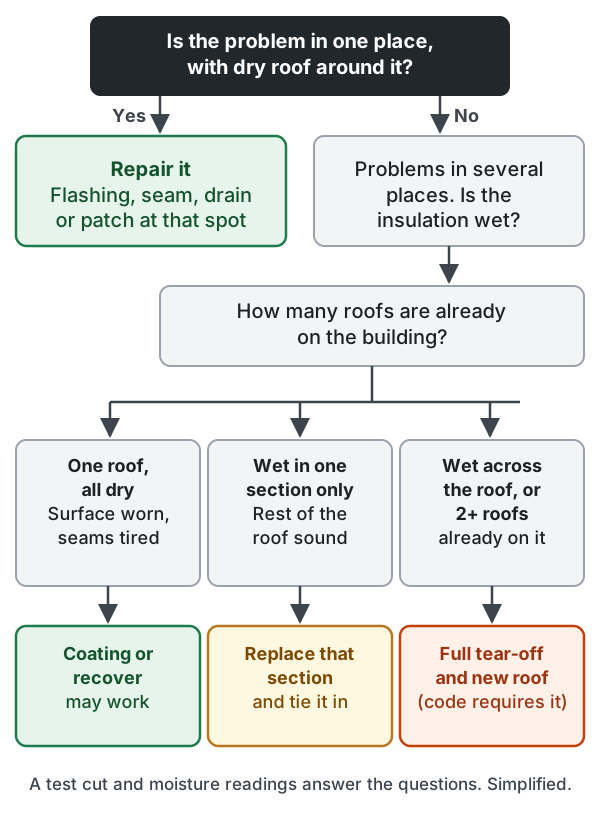
Most Manhattan flat roofs fall clearly into one box once someone has opened the roof in a few places and measured the moisture. The arguments happen when nobody has, and five roofers give five opinions from the hatch.
The four options
| Option | What it is | When it fits | What it means for you |
|---|---|---|---|
| Repair | Fix the failed spot: flashing, a seam, a drain, a blister | One problem area, dry roof around it | Fastest and cheapest; no warranty on small repairs with us |
| Coating or recover | A reflective coating, or a new membrane over one existing dry roof | Surface worn, seams tired, but insulation dry and only one roof on the building | Less disruption than a tear-off; large coated areas must meet the cool-roof rule |
| Section replacement | Tear off and replace one part of the roof, tied into the rest | Wet insulation or damage limited to one area, such as along one parapet or around a drain | Fixes the bad part properly without paying for the whole roof yet |
| Full replacement | Tear-off down to the deck, deck repairs, new insulation, new roof and flashing | Wet insulation across the roof, two or more roofs already on, or leaks everywhere | Biggest job; new roofs carry a 2-year labor warranty, plus a 20-year manufacturer warranty on materials; can bring in permits and city rules |
The code terms behind these (repair, recover, replacement) are explained on our flat roofing page, and how a full tear-off works is on the roof replacement page.
Section replacement: the option in the middle
On many Manhattan roofs, the damage isn’t spread evenly. Water gets in at one parapet wall or one bad drain, soaks the insulation in that area, and the rest of the roof stays dry. Cutting out and replacing that section, with the new roof lapped and sealed into the old, can buy years at a fraction of the cost of a full roof.
It only works when the rest of the roof really is sound. If test cuts find wet insulation in other areas too, or the building already has several roofs stacked up, a section replacement just moves the problem.
Coatings and recovers: only over a dry roof
A coating or a new membrane on top seals in whatever is underneath. Over dry insulation, that’s fine. Over wet insulation, it traps the water, which keeps rotting the deck and soaking through to the ceiling below.
The city’s building code also doesn’t allow a new roof over a wet roof, or over a building that already has two or more roofs on it (section 1511.3.1.1). Our waterproofing page covers when a coating is the right call and when it isn’t.
Checks you can do yourself
You can learn a lot before calling anyone, without walking on the roof.
From inside the top floor
- Where are the stains? One stain near an outside wall points to flashing at that wall. Stains in several rooms, or new ones every season, point to a roof that’s failing in many places.
- Do stains grow after every rain, or only after wind-driven storms? Storm-only leaks are often flashing or parapet problems, which are repairs.
- Is the ceiling sagging or soft? That’s water held in the ceiling. Stay out from under it and call.
From the roof hatch or bulkhead door, if you can look out safely
- Water still standing two days after rain. Small puddles near a drain can be fixed. Large areas of ponding suggest the roof has sagged or was never sloped properly.
- Patches on patches. A roof covered in old repairs has usually been leaking for a long time.
- Blisters, bubbles and open seams across the surface, not just in one corner.
- Flashing pulling away at every parapet and around the bulkhead at once.
Don’t walk on a roof you think is soft, and don’t step near parapets or skylights. Photos from the hatch are enough for us to tell you whether a visit is worth it.
What a roofer should check before advising you
A good recommendation is based on what’s under the surface. Before anyone tells you that you need a new roof, or that a patch will do, they should:
- Make a small test cut (patched the same day) to see how many roofs are on the building and whether the insulation is wet.
- Take moisture readings over soft or suspect areas, so you know how much of the roof is wet, not just whether some of it is.
- Check the deck at the test cut and from inside if there’s access: soft boards or rusted metal deck change the job.
- Check the drains and the slope, because a new roof on a roof that holds water will fail the same way.
- Show you photos of what they found.
We do all five, and when both a repair and a replacement are reasonable, we price both so you can choose.
What shortens a flat roof’s life
People ask how long a flat roof lasts. The honest answer is that the same membrane can last a long time on one building and fail early on the next. What decides it on Manhattan roofs:
- Standing water. Ponding wears a membrane out faster than anything else and finds every weak seam.
- Flashing that wasn’t done right, at parapets, bulkheads, chimneys and skylights.
- Foot traffic and equipment work. AC technicians, satellite installers and tenants on a roof that wasn’t meant for it.
- Layers on layers. A new roof over an old wet one starts its life on a bad base.
- Sun and heat on dark roofs, which dry out and crack surfaces sooner.
- No upkeep. Clogged drains and small open seams left for years turn into wet insulation.
That’s why age alone doesn’t settle it. A roof that’s drained well and been looked after can outlast a younger one that holds water.
Timing: when to repair now and replace later
You don’t always have to choose today. Some common cases:
- An emergency leak. Stop the water with a proper repair now, then plan the replacement for the right season and budget. Our emergency leak repair page explains the temporary-then-permanent approach.
- Winter. Some roof work is harder in freezing weather. A repair that keeps the roof dry until spring is often the sensible step.
- Co-ops and condos. A board can repair now and put the replacement in the capital budget, instead of a surprise assessment. Our co-op and condo roofing page covers how boards plan it.
- Buying or selling a building. A written report with photos tells both sides what the roof needs. See our roof inspection page.
Repair-now-replace-later only works if the repair keeps water out of the insulation in the meantime. If the roof is already wet across large areas, every month of waiting adds deck and ceiling damage to the bill.
Getting a second opinion, and red flags
It’s normal to get more than one opinion on a full replacement. When you compare them, watch for red flags in both directions:
- Someone who wants to replace without opening the roof. No test cut, no moisture readings, no photos.
- Someone who will patch forever. Sealant smeared over the same spot every year, on a roof that’s wet underneath.
- A recover offered over two existing roofs, or over a roof you know is wet. The code doesn’t allow it.
- “No permit needed” for a full tear-off without an explanation. Our roof permit guide explains when one is required.
- A price far below everyone else’s with a vague scope. Ask what exactly comes off and goes on.
Two honest roofers looking at the same test cut usually reach the same answer.
The money side
A repair is cheaper this year; a replacement can be cheaper over the next five. Our roof repair cost guide shows how to compare what you’re spending on repairs with the price of a new roof, and the roof replacement cost guide shows how to work out that price for your building.
FAQ
How long does a flat roof last?
It depends far more on drainage, flashing and upkeep than on the material. A flat roof that drains within a day or two after rain, has well-made flashing at every wall, and gets its drains cleared can last many years. One that holds water or was put over a wet old roof can fail in a few. Ask any roofer what their warranty covers and for how long.
Can part of a flat roof be replaced?
Yes, when the damage is limited to one area and the rest of the roof is dry. We cut out the wet section, fix any deck damage, install new insulation and roofing, and tie it into the existing roof. If test cuts find wet insulation in several areas, a full replacement is usually the better money.
Can I repair the roof now and replace it next year?
Often, yes. A proper repair can keep the roof dry while you plan and budget for a replacement, which suits winter leaks and co-op capital plans. It only makes sense if the repair keeps water out of the insulation. If the roof is already wet across large areas, waiting adds damage to the deck and ceilings.