Roof leaking? What to do now, and who has to fix it
Short answer: If your roof is leaking, protect people first, then your things. Keep away from wet light fixtures and outlets, put a bucket under the drip, and take dated photos. Then tell the right person. Renters tell the landlord or super. Co-op and condo owners tell the managing agent or board. If you own the building, call a roofer. If a rental landlord doesn’t act, file a complaint with 311.
This guide is written by a Manhattan roofing contractor. The tenant rules come from the NYC Department of Housing Preservation and Development (HPD), NYC311 and the New York Attorney General, linked below. It is not legal advice.
In the first hour
Water from a roof usually arrives during or right after rain, and it often comes back with the next storm. What you do in the first hour decides how much damage you end up with.
- Stay safe. If water is near a ceiling light, an outlet or a fan, switch off that circuit at the breaker and keep out of the room. If the ceiling sags, bulges or cracks, keep people and pets out from under it. If anyone is in danger, call 911.
- Catch the water. A bucket or a trash can under the drip, towels around it. Put a rag in the bucket so the drip doesn’t splash.
- Move what can be ruined. Electronics, rugs, books and furniture first.
- Handle a bulging ceiling with care. A ceiling bubble full of water can come down at once. Some people poke a small hole at the lowest point with a screwdriver, standing to the side, with a bucket under it, so the water drains where they want it. Only do this if you can reach it safely and the area is clear of wiring. If in doubt, leave it, keep everyone out and get help.
- Document it. Photos and a short video of the ceiling, the walls and any damaged belongings. Write down the date, the time, and whether it was raining. You will need this for the landlord, the board, the roofer or an insurer. If you might claim, see does insurance cover a roof leak?
- Tell someone today. See “Who has to fix it” below. Do it in writing (text or email) as well as by phone, so there is a record.
Don’t go up on a wet roof yourself. Flat roofs in Manhattan often have low parapets, open hatches and slippery membranes, and finding the leak is a job for the roofer, not for you in the rain.
Is it the roof, or something else?
Not every ceiling leak comes from the roof. A few quick checks help the person you call:
- Only when it rains, and you’re on the top floor: most likely the roof, a skylight, or the flashing around a bulkhead, chimney or parapet.
- Any time, rain or not: more likely plumbing from the apartment above, a radiator, or an AC unit draining. Call the super or a plumber first.
- On an outside wall, near a window: could be the window, the brick or the parapet above. Water can enter at the top of a wall and show up a floor or two lower.
- Below a roof deck or terrace: could be the deck’s waterproofing, the drain, or the door threshold. Our terrace waterproofing page explains how those leaks are found.
A quick test we use: if the drip starts during heavy rain and stops a few hours after, and it’s on the top floor or under a terrace, look up. If it drips on dry days, or gets worse when the neighbor upstairs showers, look for a pipe. Wind-driven rain that soaks one wall usually means the wall, the window or the parapet, not the flat roof.
Why the stain isn’t under the hole
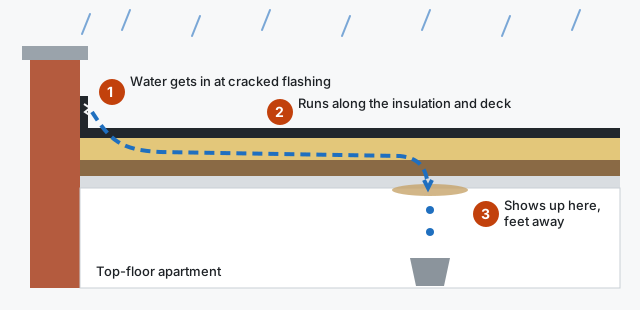
On a flat roof the water usually gets in at a joint: the flashing where the roof meets a parapet wall, a drain, a seam, a vent pipe, the bulkhead door, a skylight curb. Then it runs along the roof deck or soaks the insulation and comes out wherever the ceiling gives way first. The stain can be several feet, or a whole room, away from the entry point.
That is why patching the roof right above the stain often doesn’t work. A roofer should find the entry point on the roof before quoting a repair.
Who has to fix it
Who pays and who arranges the repair depends on how you live in the building.
If you rent
The landlord has to keep the building, including the roof, in repair. Tell the landlord, managing agent or super first, in writing. HPD’s own guidance says contacting the owner is the easiest way to get a repair done. If nothing happens, file a complaint with 311 (more below). Your landlord’s contractor may need to get into your apartment. For urgent repairs like a leaking roof or ceiling, HPD’s tenant guide says they can come without advance notice.
If you own a co-op apartment
The roof belongs to the co-op corporation, so the roof repair is usually the co-op’s job. Report the leak to the managing agent and the board in writing. What the co-op pays for inside your apartment, like plaster, paint or floors, depends on your proprietary lease and house rules, so read them. Damage to your own belongings usually goes to your own apartment insurance.
If you own a condo
The roof is normally a common element, so the condo board arranges and pays for the roof repair. Report it to the managing agent and board in writing. Who pays for damage inside your unit depends on the condo’s bylaws and on the building’s and your own insurance policies.
If you own the house or the building
It’s your roof and your call. Get a roofer to find and fix the source, and keep the photos and invoices. Brownstone owners with a shared parapet should tell the neighbor, because a leak at a shared wall can involve both roofs.
If you’re on the board or the managing agent
Get a roofer up as soon as it’s safe, ask for photos of the entry point, and tell the affected apartments what will happen and when. A temporary repair now and a proper repair in dry weather is normal. Keep a written record for the insurer.
Renters: when the landlord doesn’t fix it
If you’ve told the landlord and nothing happens, NYC has a set process. It is laid out on HPD’s page Report a Quality or Safety Issue and the 311 article Water Leak in a Building.
- File with 311 by phone, online or in the 311 app. Keep the Service Request number.
- HPD contacts the managing agent and may call you to check whether the leak was fixed.
- If it isn’t fixed, an HPD Code Enforcement inspector comes. The owner isn’t told the date of the inspection.
- If the inspector writes a violation, the owner gets a deadline based on its class:
| HPD violation class | What it means | Time to correct |
|---|---|---|
| Class A | Non-hazardous | 90 days |
| Class B | Hazardous | 30 days |
| Class C | Immediately hazardous | 24 hours (most types) |
The inspector decides the class from what they see. A slow ceiling leak and a collapsing ceiling are not the same violation, so there is no single deadline for “a leak”. For some immediately hazardous conditions, HPD’s Emergency Repair Program may do the repair itself and bill the owner.
If the problem still isn’t fixed, tenants can bring a case in Housing Court to get repairs ordered (an “HP action”). The court explains how on its HP case page, and LawHelpNY lists free legal help. Keep copies of every message to the landlord and every 311 number.
What to tell the roofer or the super
The more you can tell them, the faster they find the source:
- Which room and which part of the ceiling, with photos
- When it leaks: during heavy rain, after rain, with wind from one direction, when snow melts
- When it started, and whether it has happened before
- What is above you: the main roof, a terrace, a skylight, a bulkhead, AC units
- How to get to the roof: hatch, bulkhead door, ladder, who has the key
On a flat roof we check the usual entry points first: the flashing at the parapets and bulkhead, the coping stones on top of the walls, the drains and any standing water, the seams, and every pipe, vent or equipment curb that goes through the roof.
Temporary fix or real repair?
In bad weather a roofer may make a temporary repair: a patch over an open seam, sealant at a flashing, clearing a blocked drain. It stops the water for now. The real repair comes when the roof is dry and the source is clear, and sometimes it shows a bigger problem, like wet insulation or old layers that need to come off.
Ask the roofer to tell you which one you’re getting, and to send photos of the problem and of the finished work. Our emergency leak repair page explains how a leak call works with us.
If you rent, your landlord or managing agent arranges and pays for the roof repair. You’re welcome to send us photos and we’ll tell you whether it looks like a roof problem, but the repair itself is booked with the building’s owner or agent.
FAQ
How long does a landlord have to fix a leaking ceiling in NYC?
There isn’t one deadline for “a leak”. You tell the landlord first. If they don’t fix it and you file with 311, an HPD inspector may write a violation, and its class sets the deadline: 90 days for Class A (non-hazardous), 30 days for Class B (hazardous), and 24 hours for most Class C (immediately hazardous) conditions. The inspector decides the class from what they find.
Who pays for a roof leak in a co-op or condo?
The roof itself is normally the building’s responsibility: the co-op corporation in a co-op, the condo association in a condo. Repairs inside your apartment and damage to your belongings depend on your proprietary lease or the condo bylaws, and on insurance. Report the leak to the managing agent and board in writing, and read those documents before you pay for anything yourself.
What are my rights as a tenant if the roof leaks?
New York’s warranty of habitability (Real Property Law §235-b) gives renters the right to a livable, safe and sanitary apartment, and a lease can’t waive it. According to the New York Attorney General’s tenants’ rights guide, co-op shareholders can raise it but condo owners can’t, the landlord has to know about the problem, and withholding rent can lead to a nonpayment case. Before you take steps like that, talk to a lawyer or a free legal service through LawHelpNY.
What happens if a roof leak isn’t fixed?
The water keeps going where you can’t see it. Insulation stays wet, the roof deck and ceiling joists start to rot, plaster comes down, and mold grows in walls and ceilings. A repair that was a small flashing job can turn into new insulation, deck boards and ceilings. Fix the source as soon as the weather allows.
Sources
Official sources checked for this guide. Rules change, so check the current version before you rely on it.
- Report a Quality or Safety Issue (nyc.gov)
- Water Leak in a Building (portal.311.nyc.gov)
- HP case page (nycourts.gov)
- LawHelpNY (lawhelpny.org)
- New York Attorney General’s tenants’ rights guide (ag.ny.gov)