NYC roof permits: when you need one and when you don't
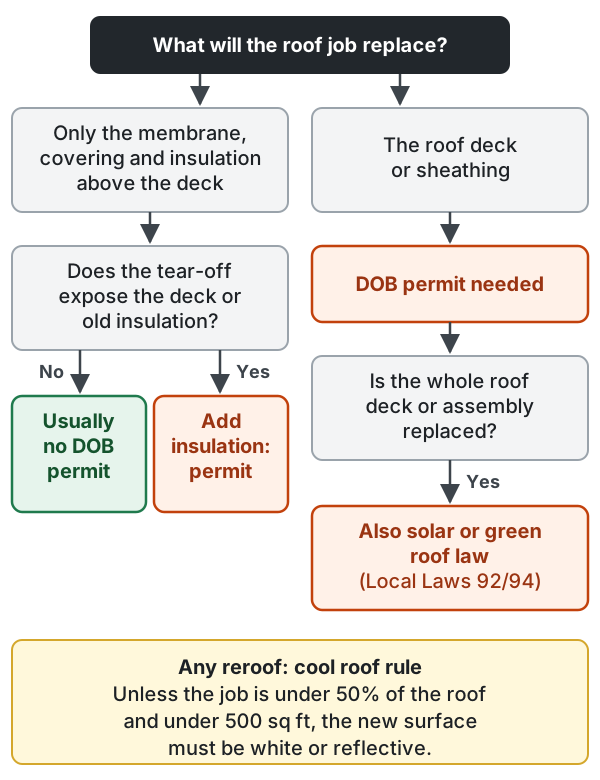
Short answer: In New York City, replacing only the roof membrane and the insulation above the deck can be done without a DOB permit, but only if the energy code doesn’t require you to add insulation. Once the job replaces the roof deck or sheathing, you need a permit. A full replacement can also bring in cool-roof rules and, if the whole roof assembly is replaced, the solar or green roof law.
The rules below come from the NYC Department of Buildings and other official sources, linked at each step. They apply to all five boroughs. Codes change, so we check them again on every job.
This guide explains the rules in plain English. It is not legal advice. For a specific building, your contractor or a registered architect or engineer should confirm what to file.
Permit applications are filed online in DOB NOW: Build, usually by a registered architect or professional engineer working with the roofer.
The DOB rule in one table
The Department of Buildings lists roof work that may be exempt from a permit in rule 1 RCNY §101-14 (Table 2, “Roofs”):
| Roof work | DOB permit? |
|---|---|
| Repair or replace the membrane, roof covering, cant strip and insulation above the deck, when the energy code doesn’t require added insulation | No |
| Repair or replace roof work that includes the deck or sheathing | Yes |
| Green roof no more than 4 inches deep, on a noncombustible building or one taller than 100 feet | No |
Two things are easy to miss:
- The list is not complete. DOB says these tables are “not an exclusive list.” Work that isn’t listed still needs to be checked.
- “No DOB permit” doesn’t mean no paperwork. The same rule says you may still need to file with other agencies, such as the Landmarks Preservation Commission, the Department of Transportation or the Fire Department, and with DOB for related work like sidewalk protection or electrical connections.
When the energy code turns a “no permit” job into a permit job
The exemption above only holds if the NYC Energy Conservation Code doesn’t require more insulation. In short:
- Recover or reroof without exposing the deck or insulation: no added insulation is required.
- Tear-off that exposes the deck or the insulation: the roof has to be insulated to current code, above or below the deck.
On Manhattan flat roofs, a full tear-off often exposes the old insulation or the deck. When that happens, the insulation upgrade is part of the job, and the job is no longer the simple exempt kind. Where adding insulation is truly impractical, DOB bulletins (2017-006, 2020-007) allow other ways to make up the lost energy, but that has to be documented.
On older Manhattan roofs, a full tear-off often shows wet insulation and some damaged deck boards. That is when the energy code and the deck rule start to matter, so we check with a test cut before we quote, and tell you up front whether the job is likely to need a permit.
Cool roof rule: the new surface has to reflect heat
The NYC Building Code (2022, section 1511.1) says that when you recover or replace a roof covering, the new surface must meet the city’s reflectance standard (section 1504.9). The only way out is a small job: less than 50 percent of the roof and less than 500 square feet. Both must be true. The rule started with Local Law 21 of 2011 and was raised by Local Law 94 of 2019.
For a flat roof, the standard is a solar reflectance of at least 0.7 with thermal emittance of at least 0.75, or a Solar Reflectance Index (SRI) of at least 82. In practice that means a white membrane, a white cap sheet or a reflective coating. A plain black or gray roof won’t pass.
Parts of the roof don’t count, including:
- areas under mechanical equipment, roof tanks and other rooftop structures
- green roof areas
- roof decks people use, if the walking surface has a reflectance of at least 0.3
- setback terraces smaller than 25 percent of the largest floor
- roofs where the space left after these exceptions totals less than 100 square feet
The same chapter also bans gravel or crushed stone as a roof surface (section 1504.8).
Solar or green roof law (Local Laws 92 and 94)
If you replace the entire roof deck or roof assembly on an existing building, Local Laws 92 and 94 of 2019 apply. The open part of the roof, called the Sustainable Roofing Zone, has to be covered with solar panels, a green roof, or both.
What helps owners:
- A lot of the roof doesn’t count. Areas needed for access and setbacks, rooftop equipment, bulkheads, parapets and guardrails are left out of the zone.
- A design professional files it. The filing goes through DOB NOW and needs a registered architect or engineer.
- There is a tax break. A property tax abatement for green roofs is requested as part of the same DOB filing; DOB’s page has the current terms.
Repairs and partial jobs don’t trigger these laws. Only a full deck or assembly replacement does.
Parapets, coping and flashing
Many Manhattan roof jobs include the parapet, the short brick wall around the roof edge. DOB’s façade table in the same rule (Table 3) lets small parapet work go ahead without a permit: repointing, new masonry coping or a sheet-metal coping cover, and replacing up to 10 sq ft of parapet in any 100 sq ft at the same height. Demolishing and rebuilding a parapet, making it taller, or cladding it in sheet metal needs a permit. Our parapet repair page explains these limits, the sidewalk shed rule for work above 40 feet, and Landmarks.
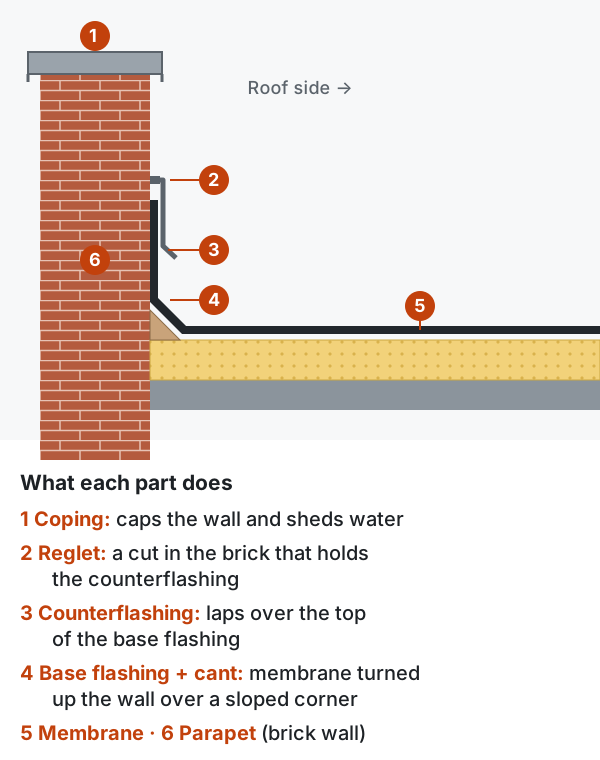
On buildings taller than six stories, parapets and copings count as part of the façade. The Façade Inspection Safety Program (Local Law 11) requires a critical examination of the exterior walls and these “appurtenances” every five years (1 RCNY §103-04). Before planning roof work on a taller building, read the last façade report. Parapet conditions rated unsafe must be repaired.
Torch-down roofing needs FDNY certificates
Torch-applied modified bitumen is common on NYC flat roofs. The Fire Department requires the torch work to be done by a holder of a Certificate of Fitness G-60, with a fire guard holding an F-60 watching the roof. Ask your roofer who on the crew holds them.
Co-ops, condos and landmarks: approvals beyond DOB
- Co-ops and condos: the board or managing agent usually has its own approval process. Expect an alteration agreement, a certificate of insurance and rules on roof access and work hours. This is separate from DOB.
- Landmarked buildings and historic districts: under the Landmarks Preservation Commission rules (section 2-11), no LPC permit is needed to replace a flat roof, including adding insulation. But any change to visible flashing, gutters, leaders or decorative elements, or new visible railings that come with the job, needs LPC review. Solar panels on a flat roof can be approved by LPC staff if they are placed to keep visibility to a minimum (section 2-21).
- Sidewalk and street: sidewalk protection is filed separately with DOB. A construction-debris dumpster on the street or sidewalk needs a DOT Construction Debris Container permit. Only a DOT-registered carting company or a registered general contractor can get one, for a job that has a DOB permit, for up to 90 days (311). Cranes and other heavy equipment on the street need their own DOT street permits.
We handle the DOB & DOT permits our roof jobs need, working with a registered architect or engineer where the law requires one.
How much does a roof permit cost?
The DOB filing fee is set by the city’s fee table (Local Law 77 of 2023, Table 28-112.2). For an alteration permit:
| Building | Minimum fee covers | Then add |
|---|---|---|
| 1-, 2- or 3-family home | First $5,000 of job cost: $130 to $170, depending on the alteration type | $2.60 for every $1,000 above $5,000 |
| Other buildings under 7 stories and under 100,000 sq ft | First $3,000 of job cost: $195 to $280, depending on the alteration type | $10.30 for every $1,000 above $3,000 |
Example: a $25,000 roof job on a brownstone filed as an Alteration Type 2 has a DOB fee of about $130 + (20 × $2.60) = $182. The same job on a small walk-up or mixed-use building comes to about $225 + (22 × $10.30) = $452. Taller and larger buildings have their own rates. DOB can raise these fees by rule, so check the current table.
The DOB fee is usually the smallest part. Architect or engineer fees, an expediter if one is used, and Landmarks or board paperwork cost more.
On our roof jobs, the permit usually comes through in 3 days to a week.
What happens if roof work is done without a permit
If DOB finds work that needed a permit and didn’t have one, it can issue a violation and a stop work order (DOB civil penalty fact sheet):
- The owner pays. The civil penalty is a multiple of the permit fee and is charged to the building owner, not the contractor. A new owner who buys the building with an open penalty inherits it.
- No permit until the penalty is paid. The work still has to be permitted afterward.
- The stop work order stays. Paying the penalty and getting a permit don’t lift it automatically. You contact the DOB unit named on the posting, and an inspector reviews the work before it is lifted. Working while it is posted brings more violations.
That is why a full tear-off without a permit is a bad bargain, even when a roofer says it will save money.
How to check a permit for your building
You can look up any address for free, without an account:
- Search the DOB NOW Public Portal by house number, street and borough. Permits filed in DOB NOW show under job filings.
- Search DOB BIS for older permits filed before DOB NOW.
For residential jobs, New York City requires the contractor to give you written notice of the permits the job needs before you sign: what kind, who gets them, the steps, the estimated fees and how to check them (DCWP).
FAQ
Can I patch a leak on my roof without a permit?
Repairs limited to the membrane, roof covering and insulation above the deck are on DOB’s list of work that may be exempt. A small patch usually fits. If the repair opens up the deck or needs new insulation, it no longer qualifies.
Who pulls the permit, me or the roofer?
On most jobs the contractor or their design professional files it. Before you sign a residential contract, the contractor has to tell you in writing which permits are needed and who will get them.
Does a roof coating need a permit?
A coating applied over the existing roof stays above the deck, so it fits DOB’s exempt repair category for work above the deck. If the coated area is 50 percent of the roof or more, or 500 square feet or more, the new surface must meet the city’s reflectance standard, so use a reflective coating.
Are green roofs or solar panels required when I replace my roof?
Only if the entire roof deck or roof assembly is replaced. Then Local Laws 92 and 94 require solar panels, a green roof or both on the usable part of the roof, with exemptions for small or unsuitable areas. Repairs and membrane-only replacements don’t trigger them.
Sources
Official sources checked for this guide. Rules change, so check the current version before you rely on it.
- 1 RCNY §101-14 (nyc.gov)
- NYC Energy Conservation Code (nyc.gov)
- 2017-006 (nyc.gov)
- 2020-007 (nyc.gov)
- NYC Building Code (nyc.gov)
- Local Laws 92 and 94 of 2019 (nyc.gov)
- 1 RCNY §103-04 (nyc.gov)
- Certificate of Fitness G-60 (nyc.gov)
- F-60 (nyc.gov)
- Landmarks Preservation Commission rules (nyc.gov)
- 311 (portal.311.nyc.gov)
- DOT street permits (nyc.gov)
- Local Law 77 of 2023, Table 28-112.2 (nyc.gov)
- DOB civil penalty fact sheet (nyc.gov)
- DOB NOW Public Portal (nyc.gov)
- DOB BIS (a810-bisweb.nyc.gov)
- DCWP (nyc.gov)