Parapet wall, coping and chimney repair in Manhattan
- NYC license 2135523-DCWP
- Free estimates
- 24/7 leak calls
- Written warranty on new roofs
Short answer: We do parapet wall repair, coping work and chimney repair on Manhattan brownstones, walk-ups, co-ops and mixed-use buildings: repointing, resetting or replacing coping stones, rebuilding cracked or leaning sections, and new flashing where the wall meets the roof. The masonry and the roofing are done by the same crew, so nobody can blame the other trade when the joint leaks. Estimates are free.
Send photos of the wall and of any stain inside, and we’ll tell you what we see.
Signs your parapet or chimney needs work
Parapets take more weather than any other wall on the building. They’re exposed on both faces and on top, so water and freeze-thaw get at them from three sides.
- Damp plaster or peeling paint high on an outside wall, usually on the top floor, worse after wind-driven rain.
- Open joints between coping stones, or coping that rocks when you push it.
- Mortar you can scrape out with a key, or sand piling up at the foot of the wall.
- Cracks running through the bricks rather than along the joints, or a wall that leans in or out.
- White salt stains (efflorescence) on the brick: water is moving through the wall.
- Flashing pulling away from the wall, or a line of tar and caulk where someone has patched it again and again.
- A chimney stain on the ceiling or wall next to it, a cracked crown on top, or loose bricks near the roof line.
If a brick or coping stone is loose on the street side, treat it as a safety problem first. Keep people away from the sidewalk below and call us.
What we do
- Repointing. We rake out failed mortar to a proper depth and refill the joints. On old brick we use a mortar that is softer than the brick, so the joint takes the wear and not the brick face.
- Coping. We reset loose stones on a fresh bed, fill and seal the joints, replace cracked stones, or cap the wall with a sheet-metal coping where stone isn’t worth saving.
- Partial rebuilds. Where bricks have cracked or the wall has moved, we take that section down and rebuild it with matching brick.
- Full rebuilds. For a parapet that leans, is cracked through, or has been patched past saving, we take it down and rebuild it, usually with through-wall flashing under the coping so water that gets into the top of the wall is led back out.
- The roof side of the wall. Many Manhattan parapets have stucco or a cement coating (often Thorocoat) on the roof-facing side. We repair it where it’s cracked or hollow, and we tell you when a coating is trapping water in an old wall instead of keeping it out.
- Flashing. New base flashing and counterflashing where the roof meets the parapet, the chimney, the bulkhead and anything else that rises out of the roof.
Repair, rebuild or just reflash?
Most people who call us expect to hear “rebuild”. Often the wall is sound and the problem is the joint at the bottom or the top.
| What we find | What it usually needs |
|---|---|
| Wall solid, damp only at the base, flashing cracked or loose | New base flashing and counterflashing; no masonry work |
| Wall solid, mortar soft or missing | Repointing |
| Coping loose or joints open, wall below is sound | Reset the coping and seal the joints |
| Coping cracked, or water already inside the top courses | New coping, often with through-wall flashing under it |
| Bricks cracked or spalled in one area | Rebuild that section |
| Wall leaning, cracked through, or loose bricks along its length | Take it down and rebuild |
We show you photos of what we found before we recommend anything. If a full rebuild is on the table and you want a second opinion from an engineer, that’s reasonable, and we’ll walk them around the roof.
Types of roof flashing on a Manhattan roof
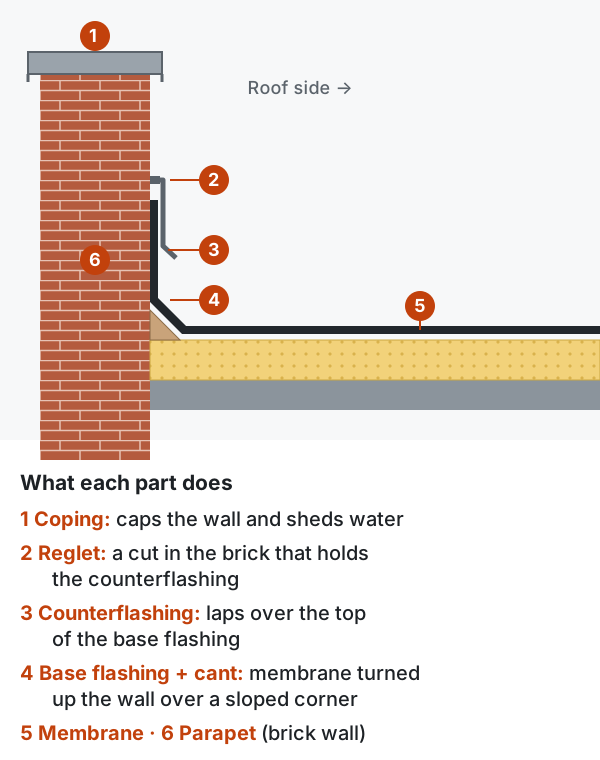
Flashing is the strip of membrane or metal that seals the joint where the roof meets something else. On a flat roof behind parapets, these are the ones that matter:
| Flashing | Where it goes | What fails |
|---|---|---|
| Base flashing | The roof membrane turned up the face of the parapet, bulkhead or chimney | Cracks at the corner, pulls away from the wall |
| Counterflashing (cap flashing) | Metal set into a slot (reglet) cut in the brick, or screwed on with a termination bar, lapping down over the base flashing | Pulls out of the reglet; sealant dries out |
| Through-wall flashing | Inside the wall, under the coping or a few courses down, leading water back out | Missing on older walls; rusted on others |
| Coping cap | Stone or metal on top of the wall | Open joints, loose stones, rusted seams |
| Chimney flashing | Base and cap flashing on all four sides, sometimes with a small cricket behind a wide chimney | The top side, where water piles up |
| Pipe and curb flashing | Around vent pipes, AC and equipment curbs, roof hatches | Cracked boots, unsealed curbs added by other trades |
| Edge flashing (gravel stop) | Metal at a roof edge with no parapet, such as a rear extension | Rusted, lifted by wind |
A good flashing repair replaces the piece, laps it correctly and fixes it mechanically. A bead of caulk or roof cement over an old flashing buys a season at best. The full list of roof problems we repair is on our roof repair page.
Chimney repair
Most chimneys on Manhattan rowhouses and walk-ups are no longer used for fires, but they still go through the roof, so they still leak. We repair the masonry from the roof up: repointing, rebuilding loose courses, a new or repaired crown, a cap to keep rain out of an unused flue, and new flashing all round.
When a chimney is no longer used at all, ask us whether capping it or taking it down below the roof line makes more sense. Taking one down changes the structure and the roof, so we check what permits it needs before we price it.
Permits, sidewalk sheds and Landmarks
Small parapet repairs don’t need a Department of Buildings permit. Under DOB’s façade rule (1 RCNY §101-14, Table 3), these are exempt:
- Repointing brick
- Replacing individual bricks in the outer layer, up to 10 sq ft in any 100 sq ft of wall
- Replacing an existing masonry parapet at the same height, up to 10 sq ft in any 100 sq ft of continuous parapet
- New masonry coping, or a sheet-metal coping cover
Anything bigger, such as rebuilding a parapet or making it taller, needs a DOB permit with plans filed by an architect or engineer. We handle DOB & DOT permits and tell you at the estimate which one your job needs. Roof permits in general are covered in our NYC roof permit guide.
Two other rules catch owners out. DOB’s own guidance notes that façade work more than 40 feet above the curb needs a sidewalk shed up before the work starts (DOB diagrams, BC 3307.6.2), which adds cost and time on taller buildings. And if the building is a landmark or in a historic district, masonry repair needs a permit from the Landmarks Preservation Commission first; for repairs that don’t need a DOB permit, that is a free staff-level Permit for Minor Work.
Parapets facing a street also need a yearly close-up observation under NYC’s parapet rule, and on buildings taller than six stories they’re part of the five-year façade inspection (FISP). Our roof inspection page explains the yearly check, and the commercial roofing page covers FISP. When either report flags a parapet, we price the repair from the report and our own look at the wall.
How a parapet job runs
- Photos or a visit. We look at both faces of the wall and the top, and inside if there’s a stain.
- A written estimate. Which sections, which repair, what permits or shed the job needs, and the price.
- Approvals. Permits, Landmarks, the board or managing agent, and the neighbor if the wall is shared. For party-wall parapets, see the shared-parapet question on our brownstone page.
- The work. Roof protected, debris lowered safely, no loose material left on the parapet overnight.
- Photos when it’s done, including the top of the wall and the flashing you can’t see from the street.
Payment is half when work starts, half when it is finished.
Cost
We don’t quote parapet work over the phone, because the price depends on things only a look at the wall shows: how many linear feet, how many courses come down, stone or metal coping, how you reach the wall (hatch, bulkhead, a neighbor’s roof), and whether the job needs a permit, a sidewalk shed or Landmarks approval. Repointing and a coping reset cost a fraction of a rebuild, which is why we check first.
The estimate is free, and it comes in writing with each item priced. For the roof itself, our roof replacement cost guide explains how roofing prices are built.
FAQ
Can a leaking parapet be fixed without rebuilding it?
Usually, yes. If the bricks are sound and the wall is straight, the leak is almost always at the flashing at the base, open coping joints on top, or failed mortar. New flashing, a coping reset or repointing fixes those for a fraction of a rebuild. A rebuild is for walls that lean, are cracked through, or have loose bricks along their length.
Stone coping or a metal cap: which is better?
Both work when they’re installed right. Stone coping matches older buildings and lasts for decades, but its joints need resealing and the stones must sit on a sound bed. A sheet-metal cap covers the whole wall top with fewer joints and is often the better fix on a wall that has been patched many times. On a landmarked front, stone usually has to stay.
Do I need a permit to repair a parapet wall in NYC?
Not for small work. DOB exempts repointing, new masonry coping, and replacing up to 10 sq ft of parapet in any 100 sq ft at the same height. Rebuilding a parapet, raising it, or larger brick replacement needs a DOB permit with plans. Landmarked buildings also need a Landmarks permit for masonry repair.
How can I tell if chimney flashing is leaking?
A stain on the ceiling or wall right beside the chimney, which gets worse in wind-driven rain, is the usual sign. On the roof, look for flashing pulled away from the brick, cracked sealant at the top edge, or tar smeared over old repairs. If the flashing looks sound, the crown or the mortar joints higher up may be letting water into the chimney instead.
Updated