Roof replacement for Manhattan buildings
- NYC license 2135523-DCWP
- Free estimates
- 24/7 leak calls
- Written warranty on new roofs
Short answer: We replace flat roofs on Manhattan brownstones, walk-ups, co-ops and mixed-use buildings. In most cases that means tearing the old roof off down to the deck, fixing what’s wet or rotten underneath, and installing new insulation, a new membrane and new flashing at every wall, drain and pipe. A full new flat roof is typically $13 per sq ft, with the exact price after a free estimate. New roofs come with 2-year labor warranty, plus a 20-year manufacturer warranty on materials.
When a roof needs replacing, not another repair
Age alone doesn’t decide it. Condition does. These are the signs we look for:
- Leaks keep coming back in different places, even after repairs.
- The roof feels soft or spongy underfoot. That usually means wet insulation, sometimes a rotting deck.
- Patches on top of patches, and several old roofs stacked on each other.
- Water still standing two days after rain over large parts of the roof.
- Blisters, cracks and open seams across the whole surface, not in one spot.
- Flashing failing everywhere at once: parapets, bulkhead, drains.
If the problem is in one place and the rest of the roof is dry, a repair is usually the better money. Our roof repair page covers that, and our repair-or-replace guide covers the options in between.
We decide from what we find, not the roof’s age: a test cut shows how many layers there are and whether the insulation is wet, and photos show you the same thing we see.
Tear-off or a new layer on top?
A new roof can sometimes go over the old one (a “recover”). It’s cheaper and faster, which is why some roofers always suggest it. But the NYC Building Code doesn’t allow it when the existing roof is wet or deteriorated, or when there are already two or more roofs on the building (section 1511.3.1.1 of the 2022 NYC Building Code). On older Manhattan buildings that’s common: we often find two, three or more layers.
A tear-off also lets us see the deck. Rotten boards, rusted metal deck or soaked insulation get fixed before the new roof goes on, instead of being sealed in. Owners on brownstone forums who chose a layer over a full tear-off often say they regret it when the leaks return.
We recommend a recover only when a test cut shows a single, dry layer over a sound deck. On older buildings we more often find two or three roofs, wet insulation along the parapets and at drains, and some rotten deck boards.
What we install
We install modified bitumen (torch-down), EPDM, TPO and PVC roofs, usually with Johns Manville materials. Our flat roofing page explains each system, and the guide EPDM vs TPO vs modified bitumen compares them.
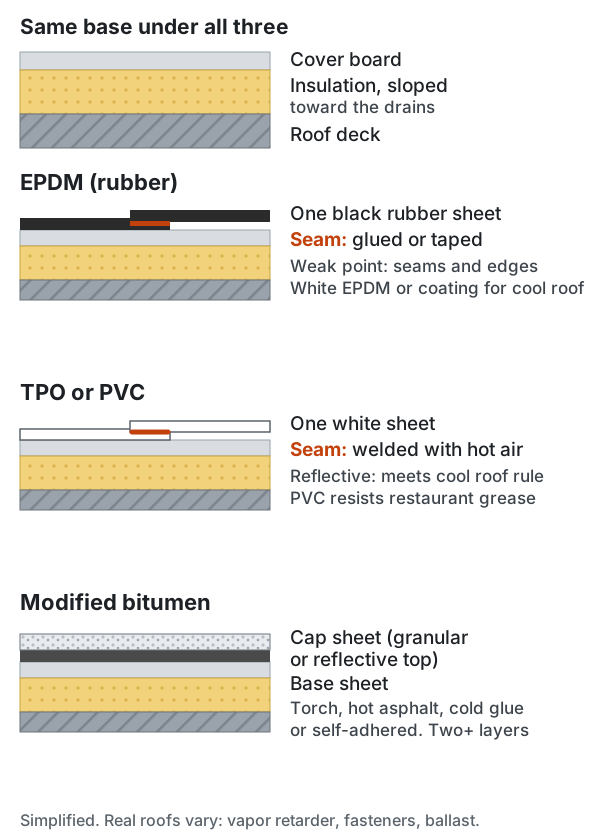
On brownstones and walk-ups we usually install a two-ply modified bitumen roof; on larger, open roofs, white TPO; over restaurant exhaust, PVC.
How a Manhattan roof replacement works
- Survey and estimate. We go up, measure, check the layers and the deck where we can, and photograph the parapets, drains and flashing. You get a written scope and price.
- Approvals. For co-ops and condos: the board and managing agent, and the building’s access or alteration agreement. For landmarked buildings: anything visible from the street. For any job: permits where they apply (see below).
- Planning the logistics. How material goes up and debris comes down: through the building, by hoist, or by crane on bigger jobs. A container on the street needs a city permit. Neighbors get notice.
- Tear-off. We remove the old roof in sections we can close up the same day, so the building is never left open to rain.
- Deck repair. Wet or rotten deck is replaced, priced per square foot as agreed in the estimate.
- Insulation and membrane. New insulation to the energy code, tapered where water needs to run to the drains, then the new membrane.
- Flashing, parapets and drains. New flashing at every parapet, bulkhead, chimney, skylight and pipe. Drains reset or replaced. Overflow scuppers kept. Coping repaired where needed.
- Cleanup and handover. Debris out, building and neighbors’ roofs cleaned, photos of the finished roof, and the warranty in writing.
A brownstone roof usually takes days, not weeks; larger buildings take longer, and the estimate gives you the dates. We cover stairs and hallways on the way up, protect neighbors’ roofs and skylights, and clean up every day.
NYC rules a full replacement can trigger
A full roof replacement in NYC isn’t only a roofing decision. Depending on the job, these rules can apply:
- Cool roof. A replacement has to get a reflective surface unless the work is less than half the roof and under 500 sq ft (section 1511.1 of the Building Code). In practice that means a white or reflective membrane or coating on most full replacements.
- Solar or green roof (Local Laws 92 and 94). When an entire existing roof deck or roof assembly is replaced, the law can require solar panels and/or a green roof on the available roof area, filed with the Department of Buildings by a registered architect or engineer. See DOB’s Local Laws 92 and 94 page.
- DOB permits. Replacing only what’s above the deck can be permit-exempt; replacing the deck needs a permit. Our NYC roof permit guide explains the rule.
- Landmarks. In a landmark district, replacing a flat roof doesn’t need a Landmarks permit, but visible flashing, railings and other elements seen from the street are reviewed (LPC Rules §2-11).
- Torch work. Torch-down roofing needs crews with FDNY certificates.
We handle the DOB and DOT permits a job needs, working with a registered architect or engineer where the law requires one. Permits on our jobs usually take 3 days to a week.
What a roof replacement costs
A full new flat roof is typically $13 per sq ft, which covers tearing off the old roof, new insulation, a new roof layer, and new flashing at the roof joints. Roofing work runs $10 to $30 per sq ft depending on the job, and the exact price comes after we see the roof. The biggest things that move it: how many old layers come off, how much deck or insulation is wet, parapet and coping work, skylights, and how material gets up to the roof.
Our roof replacement cost guide explains prices in detail.
At that rate, a straightforward 1,000 sq ft brownstone roof comes to about $13,000 before extras.
Brownstones, co-ops and mixed-use buildings
- Brownstones and townhouses: small roofs, tight access through a hatch or bulkhead, often a shared parapet with the neighbor. See brownstone and townhouse roofing.
- Co-ops and condos: board approval, a scope boards can compare, notices to residents. See co-op and condo roofing.
- Mixed-use and commercial: scheduling around stores and tenants. See commercial roofing.
Warranty
New roofs come with 2-year labor warranty, plus a 20-year manufacturer warranty on materials. The labor warranty covers our workmanship: if a seam, flashing or detail we installed fails, we come back and fix it. The material warranty comes from the manufacturer and covers the membrane itself. Get both in writing, and read what each one excludes.
The labor warranty doesn’t cover damage from other trades working on the roof, new holes cut through it, or storms beyond normal weather. Keep the paperwork, and call us before anyone else works on the roof.
FAQ
Should a 20 year old roof be replaced?
Not automatically. A 20-year-old flat roof that’s dry, drains well and has sound flashing can keep going with repairs and upkeep. If it leaks in several places, feels soft underfoot or has water standing on it after rain, replacement is usually cheaper than chasing leaks for a few more years.
Can a new roof go over the old one?
Sometimes. The NYC Building Code allows a new roof over one existing roof if it’s dry and sound. It doesn’t allow it over a wet or deteriorated roof, or when there are already two or more roofs on the building. Then the old roofs have to come off down to the deck.
How many days does a roof replacement take?
A brownstone roof usually takes days, not weeks. Larger buildings take longer. Rain, permits and deck repairs found after tear-off are what usually push the dates, and the estimate tells you the plan.
Do I need to be home, and will tenants be disturbed?
You don’t need to be home all day, but we need access to the roof (keys, hatch, bulkhead door) and someone to let us in the first morning. Tear-off is noisy for a day or two, mostly for the top floor. We work daytime hours, cover hallways and stairs, and close the roof every evening.
Updated