Flat roofs: repair, replacement and upkeep in Manhattan
- NYC license 2135523-DCWP
- Free estimates
- 24/7 leak calls
- Written warranty on new roofs
Short answer: We repair and replace flat roofs on Manhattan brownstones, walk-ups, co-ops and mixed-use buildings. We work with modified bitumen (torch-down), EPDM rubber, TPO and PVC, and we fix the parts that usually cause the trouble: flashing at parapets and bulkheads, drains, and water that sits on the roof. A full new flat roof is typically $13 per sq ft, and the exact price comes after a free look at the roof.
Flat roof systems we work on
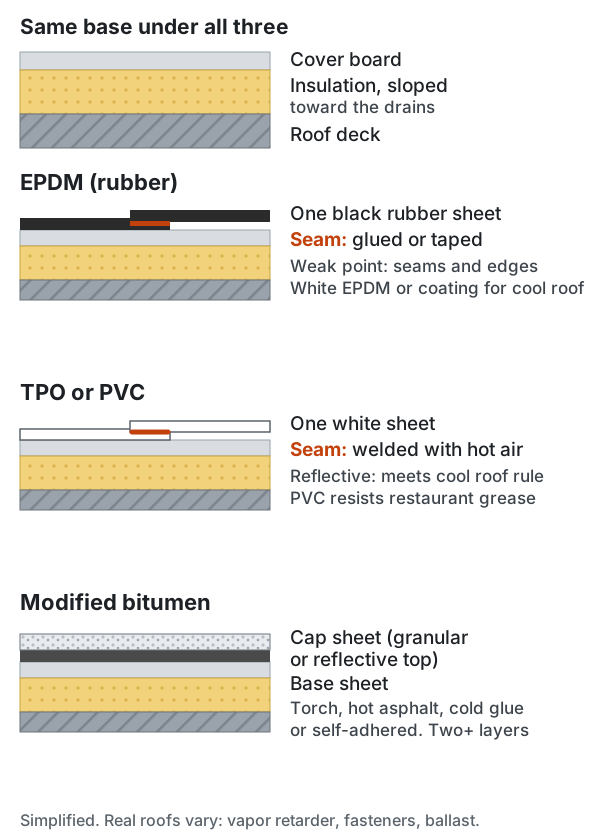
Almost every roof in Manhattan is flat or close to it. Under the surface they’re built in layers: the deck, insulation, sometimes a cover board, and the waterproof membrane on top. The membrane is what people mean when they say “torch-down” or “rubber roof”.
| System | What it is | Where it fits |
|---|---|---|
| Modified bitumen (torch-down) | Asphalt-based sheets, usually in two layers, heat-welded at the seams. The most common system on older Manhattan roofs. | Brownstones and walk-ups with lots of flashing details; roofs with foot traffic. |
| EPDM (rubber) | A large black rubber sheet, glued or held down, seams joined with tape or adhesive. | Simple roofs with few penetrations; jobs where open flame is a concern. |
| TPO | A white single-ply sheet with heat-welded seams. Reflects heat. | Larger flat roofs, roofs that need a reflective surface. |
| PVC | A single-ply sheet like TPO, also heat-welded, more resistant to grease and chemicals. | Roofs with kitchen exhaust or rooftop equipment. |
We usually install Johns Manville materials. On brownstones and walk-ups with lots of flashing details, we usually recommend a two-ply modified bitumen roof: it handles foot traffic and detail work well. On larger, open roofs a white TPO keeps the building cooler and meets the cool-roof rule. Where there’s kitchen exhaust, PVC.
Choosing between them? Our guide EPDM vs TPO vs modified bitumen compares them side by side.
Why flat roofs fail in Manhattan
A flat roof doesn’t shed water the way a sloped roof does, and Manhattan adds its own stress: hot summers on dark roofs, freeze-thaw cycles all winter, nor’easter rain driven sideways, and decades of patches from different roofers.
- Water that doesn’t drain. Low spots, a sagging deck or a blocked drain leave water sitting on the roof. Seams and flashing under standing water wear out first.
- Flashing at walls. Where the membrane turns up a parapet, a bulkhead or a chimney, it cracks and pulls away over time.
- Seams and blisters. Heat and cold open seams. Blisters form where moisture is trapped under the membrane.
- Drains and scuppers. Leaves, debris and old strainers block them; old drain bodies rust.
- Things that go through the roof. Vent pipes, AC and equipment curbs, old water-tank supports. Each one needs its own seal.
- Too many layers. Roof over roof over roof. Water gets trapped between them and the roof feels soft underfoot.
If your roof is leaking now, our roof repair page explains how we find the source.
The ones we fix most often: flashing at parapets and bulkheads (new base flashing and counterflashing), blocked or rusted drains (cleared, reset or replaced), and blistered or open seams (cut out and patched, or rewelded).
Ponding water: the 48-hour test
Some water on a flat roof after rain is normal. Water that stays is not. The NYC Building Code defines proper roof drainage as slope that lets the roof drain within 48 hours after rain (2022 NYC Building Code, chapter 2). Every flat roof system in the code has to be built that way, and a new roof over an old building has to drain properly too (section 1511.1.1).
So here’s a simple check: look at the roof two days after a good rain. If there are still puddles, the roof has a drainage problem, not just a leak.
How it gets fixed depends on why the water sits:
- Blocked or too-high drain: clear it, reset it, or lower it.
- Low spots: build them up, or add tapered insulation that slopes toward the drains when the roof is redone.
- Not enough ways off the roof: add a drain or a scupper.
- Sagging deck: repair the deck boards or joists underneath first.
When we fix ponding, we check the result the way the code describes it: after the next good rain, the water should be gone within two days.
Parapets, coping and flashing
Most Manhattan flat roofs are surrounded by brick parapet walls. They are where most leaks start.
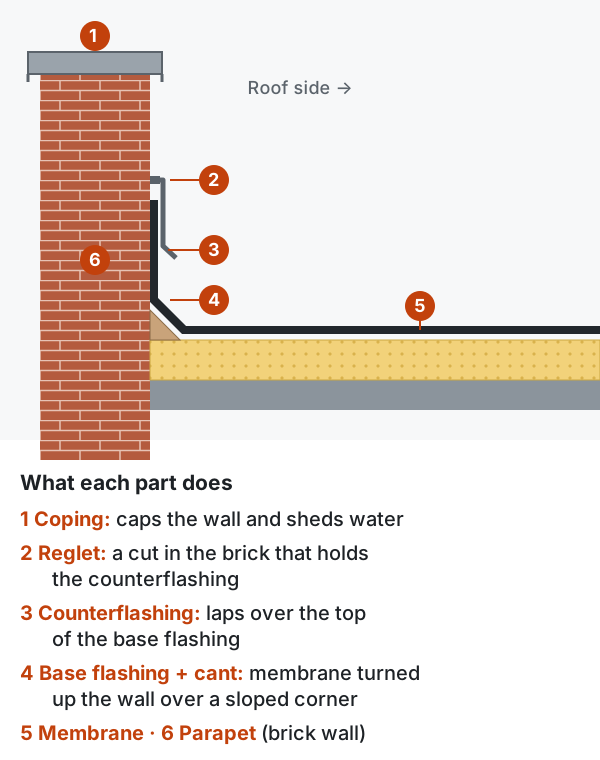
The membrane turns up the inside of the parapet (base flashing), metal counterflashing covers its top edge, and coping stones or metal cap the top of the wall. The code requires parapets to be capped with a noncombustible, weatherproof coping at least as wide as the wall (section 1503.3). When any of these fail, water gets into the wall and shows up inside as damp plaster or a ceiling stain.
When we redo a roof, we redo the flashing with it. Old, rusted flashing, metal edges and drain outlets aren’t put back (section 1511.5).
Cracked or leaning walls, loose coping and chimney leaks are covered on our parapet, coping and chimney repair page.
Buildings with a parapet facing the street also need a yearly parapet check under NYC’s parapet rule. Our roof inspection page explains it.
Repair, recover or replace?
The NYC Building Code uses three terms:
- Repair: fixing part of the roof to keep it working, like new flashing at one wall or a patched seam.
- Recover: a new roof over the existing one, without tearing it off.
- Replacement: tearing off the old roof down to the deck, fixing damaged deck, and installing a new roof.
A recover is cheaper, but the code doesn’t allow one over a wet roof or over a roof that already has two or more layers (section 1511.3.1.1). On many older Manhattan buildings that means a full tear-off. Our roof replacement page explains how a tear-off works.
As a rule of thumb, repair makes sense when the problem is in one place and the rest of the roof is dry and sound. When leaks keep coming back in different spots, or the insulation is wet across the roof, patching costs more over a few years than a new roof.
We look at three things: is the insulation wet across large areas, how many roofs are already on the building, and are leaks in one place or everywhere. One dry layer with a local problem gets a repair. Wet insulation or two-plus layers gets a replacement quote, and we show you the photos that led us there. Our guide flat roof: repair or replace? walks through the decision step by step.
What a proper flat roof job includes
When you compare two quotes for a new flat roof, check that each one says:
- Whether the old roof comes off, and how many layers
- What happens if the deck or insulation is wet or rotten, and the price per square foot for that
- Which system and brand, and how many layers or what thickness
- New flashing at every parapet, bulkhead, chimney, skylight and pipe
- What happens with the coping on top of the parapets
- How drainage is handled: drains, scuppers, tapered insulation where needed, and overflow scuppers kept (the code doesn’t let a reroof remove them unless they’re replaced, section 1511.1)
- Insulation to the energy code, and a reflective surface where the cool-roof rule applies
- Permits, if any (see our permit guide)
- Cleanup, debris removal and protection of the building
- The warranty: labor and material, in writing. Ours is 2-year labor warranty, plus a 20-year manufacturer warranty on materials.
If one quote is much lower, it usually leaves one of these out.
Coatings: when they help
A coating (silicone, acrylic or similar) over a sound, dry roof can buy time and reflect heat. It doesn’t fix wet insulation, open flashing or bad drainage, and it can make later repairs harder. Our roof waterproofing page covers coatings in detail.
Prices
- A full new flat roof is typically $13 per sq ft, covering tearing off the old roof, new insulation, a new roof layer, and new flashing at the roof joints.
- Roofing work in general runs $10 to $30 per sq ft, depending on the job.
- A small leak repair is about $1,000, depending on the job. See the roof repair cost guide for what moves repair prices.
The exact price comes after we see the roof. What moves it: how many old layers come off, wet insulation or deck repairs, parapet and coping work, skylights, and how hard it is to get material up to the roof.
Our roof replacement cost guide explains prices in more detail.
Keeping a flat roof working
A flat roof lasts longer when someone looks at it on a schedule. The basics:
- Keep drains and scuppers clear, especially after fall leaves.
- After heavy rain, check for water that’s still there two days later.
- Look at the flashing along parapets and around the bulkhead for cracks or gaps.
- Watch for blisters, open seams and soft spots.
- Keep foot traffic, furniture and equipment off the membrane unless there’s a walkway.
We offer maintenance visits, usually in spring and fall: drains cleared, flashing and seams checked and resealed, parapets and coping looked over, photos sent after each visit. Ask us for a price for your roof.
FAQ
Can flat roofs be repaired?
Yes. A leak at one flashing, a split seam, a blocked drain or a few blisters can be repaired without replacing the roof, as long as the rest of the roof is dry and holding up. When the insulation is wet across large areas or leaks keep showing up in new places, repairs stop paying off and replacement is the better money.
Why does water pond on my flat roof, and how long is too long?
Water ponds where the roof is flat or low, where a drain sits too high or is blocked, or where the deck has sagged. The NYC Building Code expects a roof to drain within 48 hours after rain. If puddles are still there two days later, the drainage needs work: clearing or resetting drains, building up low spots, or tapered insulation when the roof is redone.
Which flat roof system do you install, and why?
We work with modified bitumen (torch-down), EPDM, TPO and PVC, usually with Johns Manville materials. On brownstones and walk-ups we usually recommend two-ply modified bitumen, because it takes foot traffic and detail work well. On larger, open roofs, white TPO. Over kitchen exhaust, PVC.
How often should a flat roof be checked?
Twice a year, in spring and fall, and after any big storm. Clearing drains and catching a cracked flashing early is far cheaper than fixing a ceiling.
Updated